
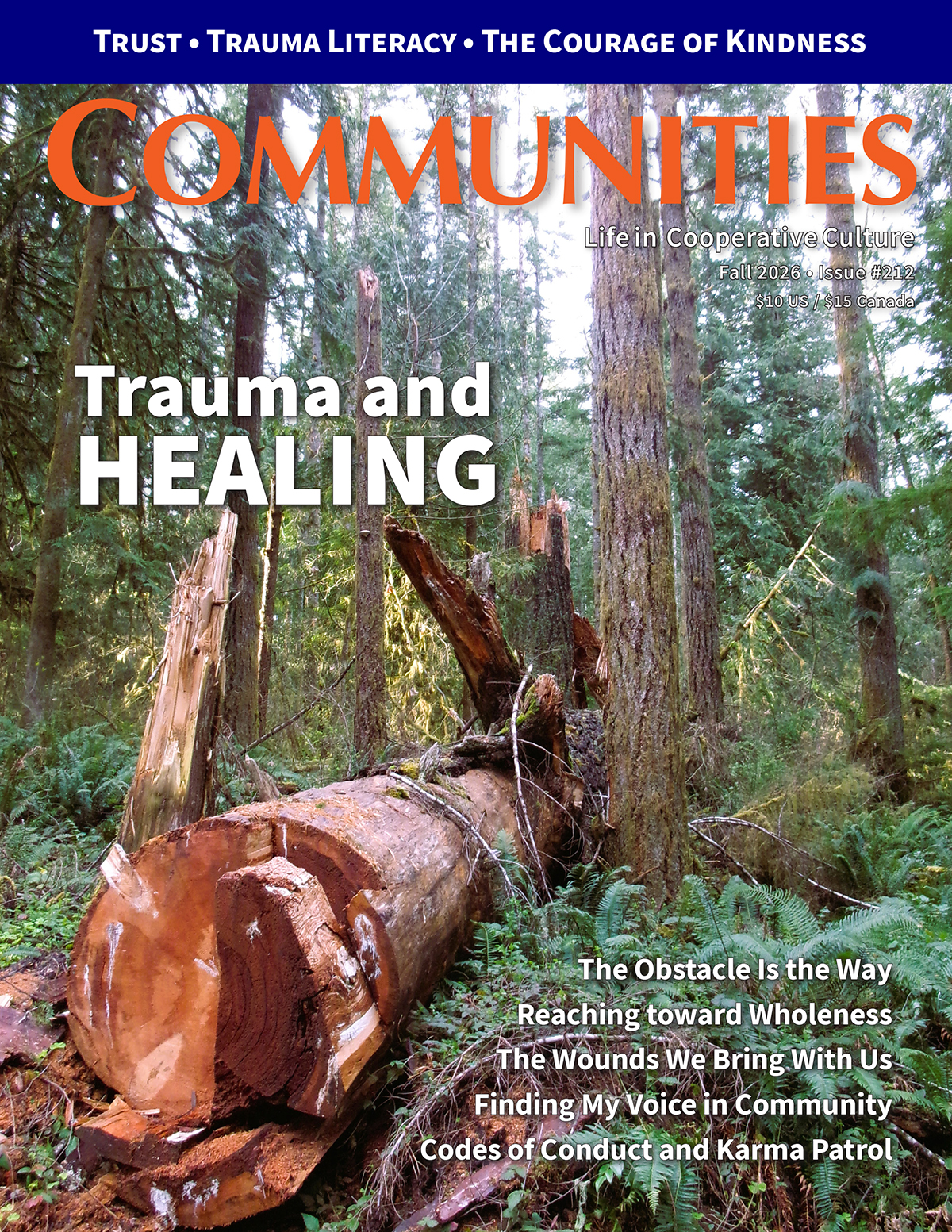
Communities #212
Fall 2026
Trauma and Healing
Note: You can order a copy of this issue here.
Communities #212 (Fall 2026) explores Trauma and Healing from a wide range of perspectives. Authors share stories of traumatic collective events in their home communities and how their groups responded; past personal traumas and their present-day effects in community; experiences of new personal trauma within community; the science of trauma and PTSD; and strategies and practices for healing and prevention. We also look at the particular challenges and opportunities of dealing with trauma in group contexts—whether personal, collective, or broader cultural, political, or ecological trauma.
Notes from the Editor: Trauma, Healing, and Writing by Chris Roth
Trauma and Trust by Emeshe Amadé
How do we give people the opportunity to be their best selves, but also prepare for the moments when they are at their worst? How do we create systems which support trustworthiness rather than assume it?
The Weight of Invisible Regulation: Trauma and Emotional Labour in Regenerative Culture by Laura van Wijngaarden
The very values that drew us together—openness, inclusion, anti-domination, and trust in emergence—also made it difficult to set limits, step into clear authority, and intervene early when dynamics became unhealthy.
The Wounds We Bring With Us: Trauma Literacy, Response-Ability, and Regenerative Community Practice by Jillian Hovey
As more people in a community develop the capacity to respond rather than letting reaction lead, activation can become something the group learns from, rather than something the group has to organize around or avoid.
The Obstacle Is the Way: Processing Trauma by kaseja wilder
Your pain and trauma are meant to transform you. This is done through integration. Trauma is treasure. You must go at the speed of trust: practice a little today, more tomorrow.
Reaching toward Wholeness: Healing Trauma in Cohousing by Joann Lutz
The antidote to the potential for traumatic experiences is strong, repeated experiences of safety. The potential for living in a community where interpersonal safety, in all its dimensions, is a priority is the best reason I can think of to live in cohousing.
Half Baked and Rubbed Raw: Motherhood, Trauma, and Finding My Voice in Community by Dena Smith Ellis
When a group of seekers comes together—each carrying their own history of pain and longing—those wounds do not disappear simply because people share land or ideals. Sometimes they intensify.
The Courage of Kindness by Dena Smith Ellis
In communities that seek to heal, kindness—not niceness—is what allows truth to surface, relationships to deepen, and real trust to grow.
Helpful Tools and Intentions to Create Trauma-Informed Intentional Communities by Leon Tsao
When people have rituals that create a sense of kinship and connection, it is easier to provide constructive feedback from a place of good intention and receive that feedback with openness.
Trauma, Codes of Conduct, and Karma Patrol by Aryana Farsai
Traumas from the past and present are parts of all groups, and the undercurrents of tensions from the past are always present. It is how we deal with this as a community that matters.
A Chaplain’s Tips for Dealing with Community Trauma by U.R.I.
There is great healing power in developing and utilizing listening skills. I can also help others by not giving personal advice but pointing to those who are trained to give advice. Listening to those in trauma IS love.
From Personal to Collective: Trauma Treatment as Violence Prevention by Rebecca Hyman
Braiding together the clinical and political frameworks for understanding violence allows us to find new ways to support the body’s healing, whether that body is individual or collective.
Trauma and Community: Why Good Governance Is Not Enough by Dan Antonioli
Nonviolent communication and consensus decision making can help, but we also need to develop more emotional literacy and awareness of people’s sensitivities to transform how we relate to trauma.
Archetypes for Healing Trauma by Kara Huntermoon
I heard the voices of female archetypes speaking to me, and realized that all four—Maiden, Mother, Crone, and Queen—are necessary for an integrated and mature female power.
The Healing Journey by Dianne G. Brause
Pain and trauma came in many variations and was shared in many ways. Sometimes, a participant would run out into the forest and wail his/her pain away. Often, someone would cry softly as they were held and rocked by several caring assistants.
Homeward Bound through Smoke and Sound: Nature, Nurture, Endless Streams, Cigarettes, and Magazines by Chris Roth
When I left my home and my family I was no more than a boy, in the company of strangers, in the quiet of a railway station, running scared. And that was before the Sledgehammer Incident.
Lessons from Wheatsville by Paul Freundlich
Remembered or not, credit for successfully passing the torch without burning down the house belongs to all those whose choices to commit made a difference.
REACH
A New Era for GEN and FIC
Digital-Only (see gen-us.net/persephone and gen-us.net/broken):
The Story of Persephone by Kara Huntermoon
Persephone married Hades, a faithful husband who loved to support his wife’s projects. Unlike the other gods, he never cheated on his wife. When Persephone decided to spend half of each year with her mother and the flowers, Hades took a pass. He liked to stay underground, thank you!
Broken Open—and Emerging More Whole: Loss, Joy, and Reinvention through Community by Thomas Mengel
I learned to sit with disorientation rather than flee it, and to ask not “what am I losing?” but “what am I feeling?,” “what do I make of this?,” and “what does this make possible?”
ON THE COVER: As climate change impacts western Oregon, some older Douglas fir trees have been dying and toppling due to drought and heat stress. Groups of three or four people with arms spread wide, fingers touching, were once necessary to enclose the largest old-growth fir in the neighborhood of Lost Valley Education Center. Now it’s become a wildlife-friendly snag (visible in background) and future nurse log for shade-tolerant species, though its blockage of an adjacent forestry road was cut short. Photo by Chris Roth.