
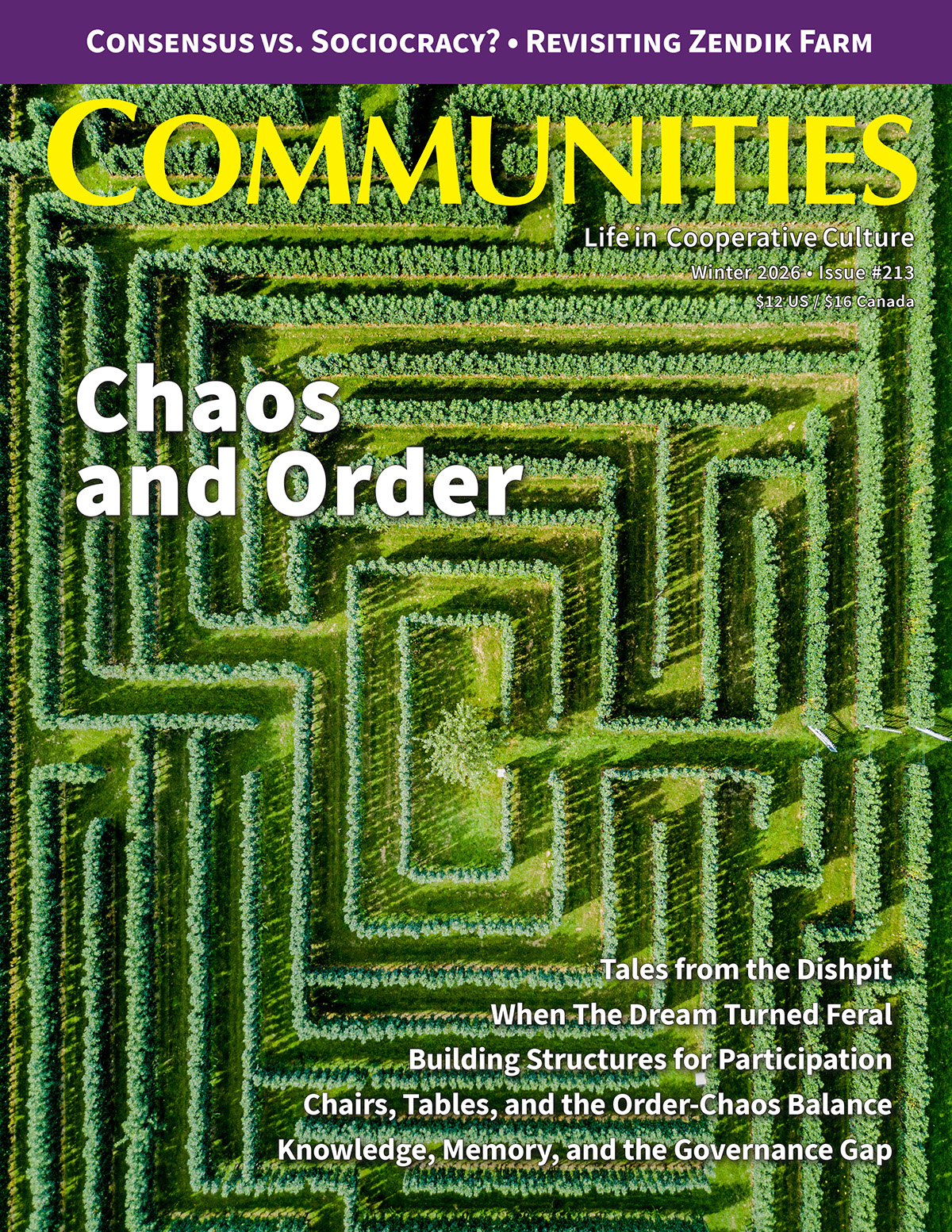
Communities #213
Winter 2026
Chaos and Order
Note: You can order a copy of this issue here.
Communities #213 (Winter 2026) explores how groups balance the forces of Chaos and Order. Where is the fertile middle ground that allows spontaneity, creativity, and inspiration to coexist with functional structure, accountability, follow-through? How do communities maintain continuity while also evolving, and stay flexible and adaptable while also retaining core values? How do we balance freedom with responsibility, organic flow with organization? What approaches best encourage fairness, participation, trust, and group endurance? And for that matter, what are our agreements about doing the dishes? Our authors have stories about all that—and also delve into consensus/sociocracy, a new bell-shaped-curve model for understanding community dynamics, a new documentary and new book, and more.
Letters: Some Food for Thought (if Bearly) by Richie Graham
Notes from the Editor: More Chaos Ahead by Chris Roth
Chaos—Kosmos—Nomos: What Keeps a Community Alive? by Kristina Jansen
How can a community create enough order to hold people without losing the ability to examine—and remake—that order? The challenge is not to preserve the founders’ magic. It is to keep the community capable of generating new life when their magic is no longer sufficient.
Holding What Matters, Without Closing What’s Possible by Laura van Wiingaarden
At Liminal Village, signals pointing toward a need for greater clarity, responsibility, and follow-through often met resistance. When structure itself is associated with control, both the signal and the response it calls for can be rejected.
Chaos According to Whom?: The Orders We Live Inside and Carry Within Us by Jillian Hovey
We often come wanting to live differently from the systems we have known, but we do not necessarily agree about what should be organized, who should take responsibility, or what freedom should look like.
Clear, Adaptable, Accountable: Building Structures for Participation by Bea Becker
If there is one lesson OSCA might offer the broader communities movement, it is in how to build community structures that actively support participation in a diverse and busy member population that is constantly changing.
Beautiful Chaos, Resilient Future by Ezra Stevens
At an agroecology farm, the work felt as organic and invigorating as breath. The community’s approach to labor was absolute chaos to the time-controlled, top-down-managed working world I had known. Yet so much work happened.
When The Dream Turned Feral: Chaos, Order, and the Community that Broke Itself by Corbin Prydwen
The tension between chaos and order wasn’t philosophical. It was daily life. Governance became improvisation. Social relations became crisis management. Shared facilities became battlegrounds.
Tales from the Dishpit: Can the Sink Sink Community Morale? by Bruce Horowitz
Once it’s developed an appropriate system, instead of engaging in dish drama, a community can use that energy to tackle all the other interesting and potentially challenging tasks that co-creating community requires.
Responsibility, Ecstasy, and Love While Doing Dishes by Vera Franco and Devin Gleeson
You realize you’ve been thinking WAY too small. The entire community has been thinking too small. You have been doing the dishes as if doing the dishes is only about doing the dishes.
Dish Karma by Eric Wolf
Here is your opportunity… / To care for another / To pay your Dish Karma / To save another from the Law of Dish Dharma.
Chairs, Tables, and the Order-Chaos Balance by Sharon Villines
During meals, as soon as I opened the door, I knew: if it sounded more like a football game, the tables were arranged as long tables. If the voices were at conversation level, the tables were arranged individually.
Community of Technical Debt: Knowledge, Memory, and the Governance Gap by Joshua Bechtel
To support equity, participation, trust, and long-term viability, the knowledge a community needs to function should be documented thoroughly, not just stored in its founding generation’s memories.
Consensus vs. Sociocracy? by Kavana Tree Bressen
Instead of getting lost in biased comparisons, stuck in the mire of “this version good, that version bad,” fellow practitioners can get curious together, learn about all the possibilities, and explore which one best fits what situation.
The “Pushers” and the “Stoppers”: Community Conflict and the Bell-Shaped Curve by Diana Leafe Christian
For a Pusher, being stopped is intolerable, like slowly having one’s energy and enthusiasm drained away. For a Stopper, being rushed and pushed is intolerable. It feels unsafe, dangerous.
Revisiting a Communal Crucible: Surviving Zendik Farm by Chris Roth
In Zendik Farm new members found a tribe to belong to and healthier ways of living and relating, albeit much of it created not by the wide-scale social pressure and limitations of the “Deathculture” but by very focused social pressure and restrictions coming from Zendik’s founders and inner circle.
Review: The Key Is in the Breastbone: A Creative Coming of Age by Chris Roth
Tracing her many years as a pioneering back-to-the-land communitarian in remote BC, as well as her previous life (including marriage to The Farm’s future founder) and her artistic evolution, Carol Ladas Gaskin’s memoir is beautifully written, intimate, evocative, engaging—and highly recommended.
Review: Dying Together: The Art of Community Death Care by Yana Ludwig
If my experience is any indication, Lee Warren’s Dying Together has the potential to root the reader in a slower, more meaning-infused life, regardless of how close to or far from our own deaths we are.
Wish for the World by Kathryn H. Hug
I want the world to be a place where everything matters, cooperation and collaboration are essentials, good health is basic, differences are respected, equality is for all…
REACH
News from Our Partners: Building Resilience, Communities Tour
Digital-Only (see gen-us.net/FEC and gen-us.net/eco-obsessed):
The FEC at 50: Communal Economics, Childcare, Networking, and the IRS by A. Allen Butcher
My suggestion to the Federation communities is to take advantage of the IRS threat and begin to use religion, in addition to governance and economics, as means for building gender-partnership and human-and-nature partnership culture.
The Beauty of Disorder: Confessions of an Eco-Obsessed Mother by Cara Judea Alhadeff, PhD
Collectively we can move beyond what we think we know. We plant realistic seeds of change (the permaculture chaos of natural order), not fabricate fixed solutions (modernity’s order).
ON THE COVER: Order and Chaos are never far apart. Per Wikipedia: “In Greek mythology, the Labyrinth…is an elaborate, confusing structure designed and built by the mythological artificer Daedalus…to hold the Minotaur, the monster eventually killed by the hero Theseus. Daedalus had so cunningly made the Labyrinth that he could barely escape it after he built it.” Here, gardeners have replaced the Minotaur with a central tree, and installed three swinging white gates to assure easy exit in a pinch. Photo from Adobe Stock.