
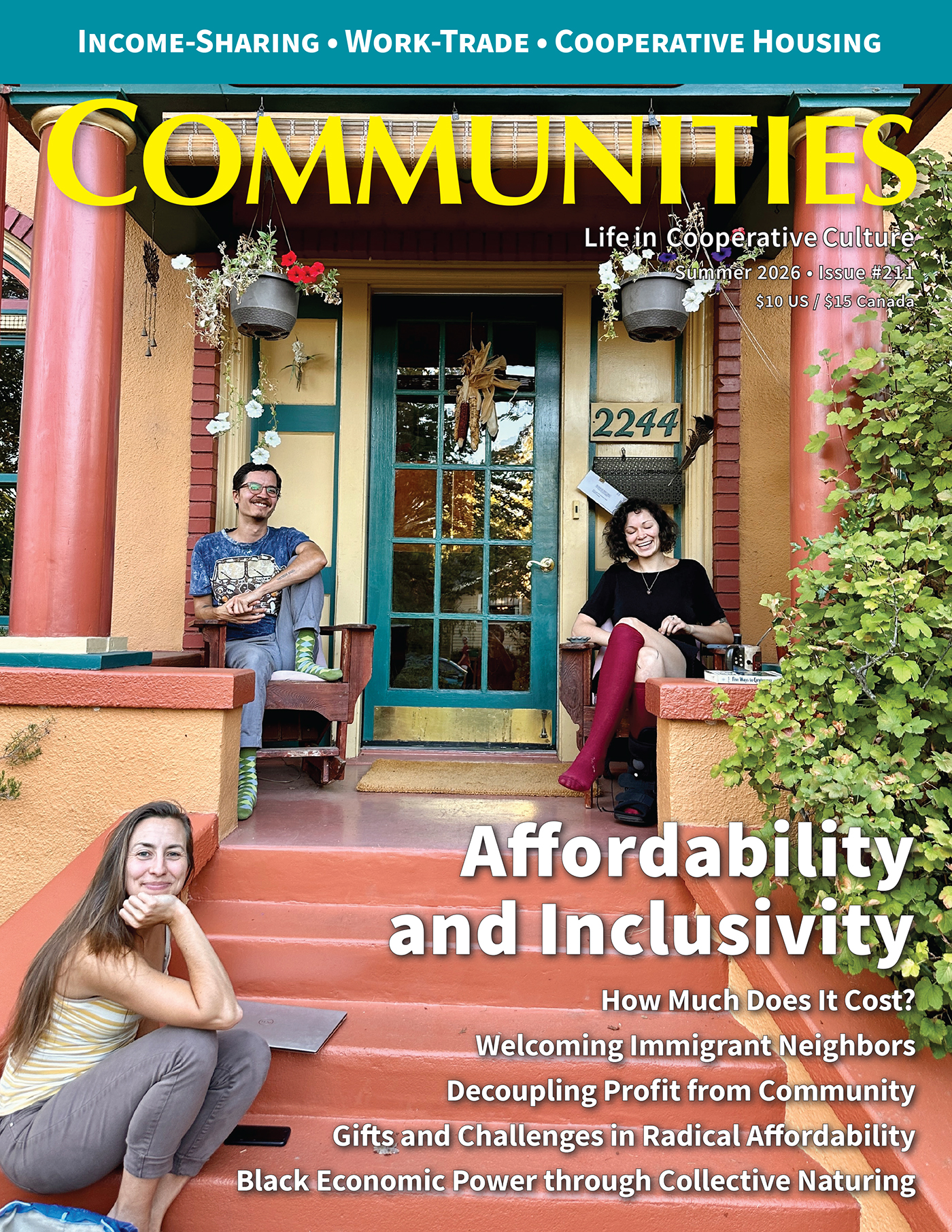
Communities #211
Summer 2026
Affordability and Inclusivity
Note: You can order a copy of this issue here.
How affordable is life in an intentional community? How inclusive of people of different means and identities? The answers are as varied as communities themselves. Communities #211 (Summer 2026), Affordability and Inclusivity, explores how groups are making communal life more accessible—or not—through a wide range of strategies, financial structures, governing philosophies, and opportunities, including cooperative housing, work-trade, small-footprint living, income-sharing, reclaiming connection to the land, and more. Authors describe challenges as well as success stories, sharing resources to help communitarians and community-seekers alike.
Letters: Life Is Short; Cognitive Impairment Stories? by Mary Minor, Anonymous
Notes from the Editor: My One Cent by Chris Roth
How Much Does It Cost? by Cynthia Tina
The cost of living in an intentional community can range from more expensive than conventional housing to dramatically more affordable, depending on where it is, how it is structured, and what kind of life you want to lead.
Decoupling Profit from Community by Savannah Fishel
True inclusivity in intentional community is often built upon specific financial mechanisms that decouple having a roof over your head, and neighbours who care, from the speculative market.
From Shared Dreams to Shared Ownership: How Cooperative Housing Can Root Communities for the Long Haul by Garlynn Woodsong
Too often, when choosing a legal structure, intentional communities default to private ownership models like condos or single-family homes, or nonprofit rental formats. What many miss is this third path, hiding in plain sight.
The Jedi Path Into Community: Why Work-Trade Is the Stealthiest Way to Learn to Live Together by Bruce Horowitz
What if there were a way to step into community life without buying land, signing a lease, or pledging your next decade to a shared vision board?
Radical Rural Affordability in the Tiny House Village by Murphy Robinson
We hope that our story can be an inspiration for others who want to live in community but don’t have the money to join an elite cohousing community or to purchase enough land for a formal ecovillage.
Finding Home: Ideals and Limitations at an Income-Sharing, Egalitarian Commune by Adam Reich
The structure of Alpha Farm does make it more accessible to folks of varied class backgrounds, though one’s economic status can still limit access and impact the experience of living there.
Black Economic Power through Collective Naturing: Our road to remembrance by Danyale Brown
We are natural beings living on a finite natural planet, gifted with the opportunity to give back to it by the indigenous peoples of lands all around the world. We’ve taken the wrong path for long enough.
Welcoming Immigrant Neighbors into Our Communities by Anonymous
We have found that by inviting immigrant community members to join our cohousing neighborhood, we are living by our values of inclusivity and enriching our community.
Gifts and Challenges in Radical Affordability by Kyla Wargel
The Bloomington Catholic Worker project was a steady reminder of the harm and instability our society creates and was an experiment in using community as a balm for that harsh reality.
Affordable, Inclusive Cohousing? by Kathryn-Jane Hazel
Buying a unit in our cohousing community is hard, especially for young families. But within the constraints of BC’s housing market and cost of living, we are doing our damnedest to make it affordable.
A Prescription for Community by Philip Mirkin
If you want to keep your nervous system intact, it might be best to build community outside rather than within the Divided States—and follow these guidelines.
Living in Community at 75 by Bruce Dobb
My fellow members beat the hell out of their asparagus and manage to combine black beans with every last dish. But it is well worth the mangled food stuff for the lively talks and fun of being with others.
Why I Choose to Live in Community by Mac Maguire
In conventional society, I would have much less opportunity to shape my neighborhood in positive ways. Community life can help heal the many wounds of nature, nurture, and neglect.
● Affordable Communities Policy
Affordable, Small-Footprint Living in an Inclusive Urban Group House by Cathy Holt
As a person with few possessions and a desire to live simply and ecologically in my older years, I believe Du•má has raised my standard of living immensely.
The Neighborhood Lore by Paul Graham
Ed, when Jan asked him, said he didn’t believe in buying and selling land. Jan said to Ed, “Well, you could just give me the land.”
Who Shares? How the communities movement is inspiring international research on willingness to share residential spaces by Robert Boyer
We found that in every country, the proportion of people interested or maybe interested in sharing was much higher than the proportion of people with prior experience sharing.
REACH
News from Our Partners: Regional Convergences Build Stronger Networks; Help Build a Global Commons by Foundation for Intentional Community, Global Ecovillage Network
ON THE COVER: At Du•má Community in Eugene, Oregon, extensive sharing, abundant on-site food production, renewable energy features, and a walkable/bikeable urban setting help make affordable, small-footprint living possible in a 100-year-old group house. Pictured: residents Alli, Benji, and Sophia on the front porch. See article on pages 42-45. Photo by Mike Tuesday-Wagner.