
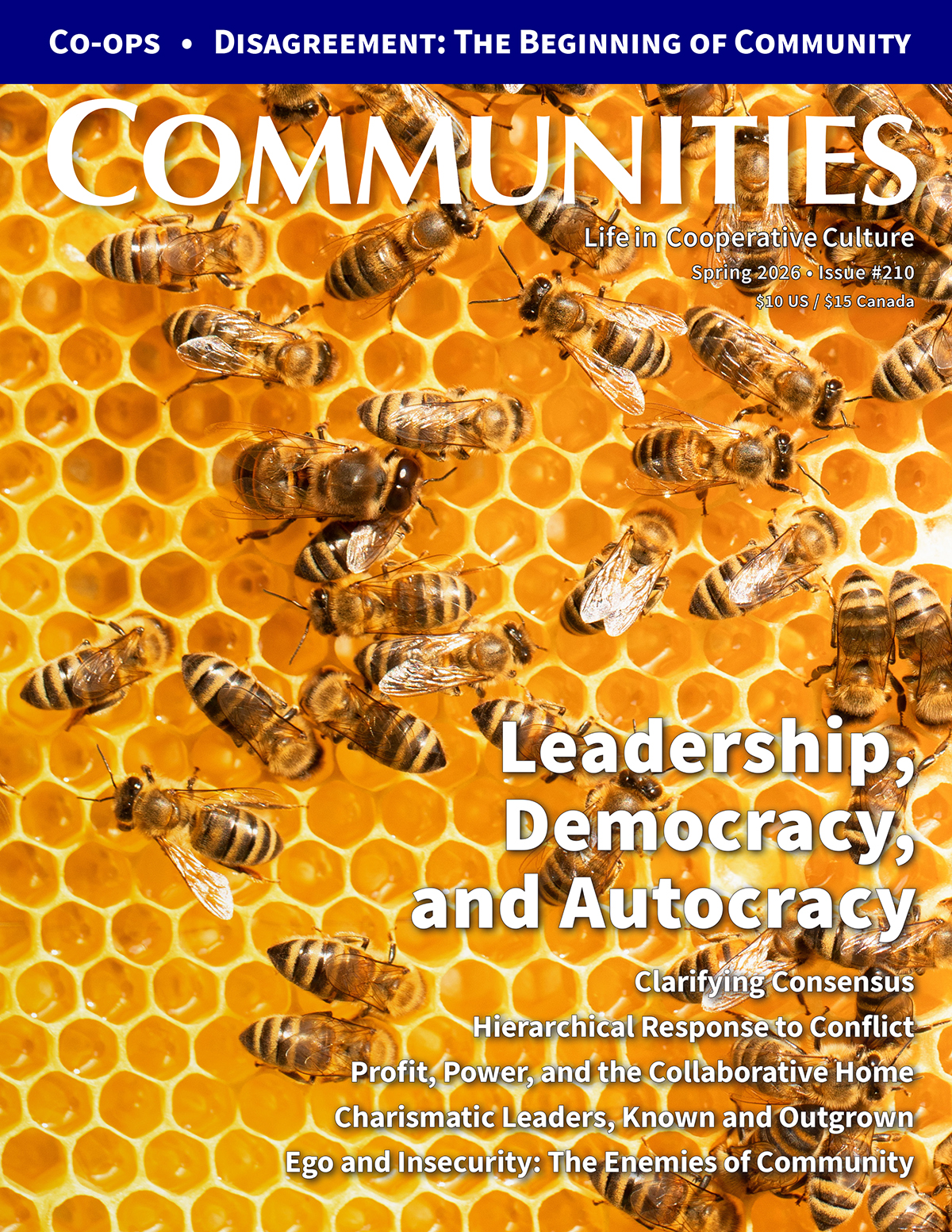
Communities #210
Spring 2026
Leadership, Democracy, and Autocracy
Note: You can order a copy of this issue here.
Communities #210, Spring 2026, “Leadership, Democracy, and Autocracy,” explores how communities address questions of authority, influence, governance, and power. Stories trace the heydays and falls of three different charismatic leaders whose groups’ identities were deeply intertwined with their own. On the other end of the spectrum, authors describe cooperative projects where no one was “in charge” and in fact nothing was compulsory, but everything got done. Articles depict decision-making systems spanning the spectrum from committed egalitarianism with no hierarchy, to merit- and seniority-weighted influence, to power concentrated in a small group. We discuss different versions and adaptations of consensus, the impacts of landlord-tenant dynamics, and what a community’s attitude toward disagreement and conflict says about its social health and long-term viability. We also hear about one group which slid from democracy toward autocracy, melted down, then ultimately recovered its democracy—both a cautionary tale and inspiring proof that the road to oligarchy and kakistocracy does not need to be one-way or forever.
Notes from the Editor: A Little Too Relevant?; Getting Over Being Tariff-ied by Chris Roth
“I think the world is going to be saved by millions of small things,” Pete Seeger used to say. We are each capable of doing some of those things when we work together.
Letters: Finding (Dis)AIgreement; The Farm’s Legacy Revisited by Elizabeth Barr, Martin Holsinger, Dr. Nimi Langer
AI’s effects and (un)sustainability; communards in Israel; and the fallibility even of visionary, charismatic, exceptionally articulate leaders.
How One Community Led to Another by Tom Atlee
On November 15, 1986, our ragtag mobile community finally marched into Washington, DC with 1200 people, having talked with thousands of people along the way—and STILL with no one in charge.
Charismatic Leaders, Known and Outgrown by Chris Roth
There may be no better way to understand the importance of shared self-empowerment than the experience of giving up one’s power in a setting where a single person commands an inordinate amount of it.
Charisma Gained, Charisma Lost by Martin Holsinger
Stephen’s overconfidence and pride blinded him to what he was missing by not having a mentor himself. And as time went on, more and more of us had interactions with him that went clunk. instead of flash!
Disagreement Is the Beginning of Community by Dave Booda
When we accept that disagreement is just part of the human experience, we start to build resilient communities of people from different walks of life who bring diverse skills and viewpoints.
Clarifying Consensus by Marty Klaif
In each training, comparisons always contrasted a hyperbolized worst of Consensus process to the purity of Sociocracy process at its best. In practice, well-designed and -facilitated Consensus process has a great deal of flexibility and benefit.
Ego and Insecurity: The Enemies of Community (A Case Study in Self-Disenfranchisement) by Chris Roth
Why would any group willingly give up democracy? Why would members ever choose knowingly to disenfranchise themselves—to surrender their own right to vote? (Was it to provide fodder for this article, nearly two decades later?)
Hierarchical Response to Conflict at Heart-Culture Farm Community by Kara Huntermoon
When we acknowledge rational hierarchies and link community decision-making to them, we can reduce structural conflict and help things go well in our homes.
Growing Leadership in the Next Generation by Helen Gabel
It’s been hard to pass leadership from members of the boomer cohort, who may have spent an entire career as an engineer or a forester or a project manager, to those who are much less experienced.
Cooperatives Are the Next Revolution by Alexis Zeigler
Many Quakers have a history of working together, of putting aside their egos for the sake of a higher cause. But getting large eclectic groups of people to work together is not easy.
Profit, Power, and the Collaborative Home by Daway Chou-Ren
A new vision still compels me: a home where the value we generate is held by the community and for the community. One where there’s no landlord, whether on the lease or in practice.
The Larger Significance of Small Communities by James L. Payne
In their quiet, patient way, intentional communities energized by active neighbors express the healthy principles we need for a better life.
Cooperative Identity At Stake: How do we develop communities of compassion, care, and love? by Thomas Mengel
Cooperative communities today can glean from the love-compassion-care-based approach and relationship-building so central to many belief systems.
REACH
News from Our Partners: COP30 and More; Building the Future Together
The Global Ecovillage Network and the Foundation for Intentional Community expand their community-building activities.
ON THE COVER: Honeybees store nectar on honeycombs. See Honeybee Democracy by Thomas D. Seeley, Princeton University Press, 2010. From the book’s descriptive text: “Honeybees make decisions collectively―and democratically. Every year, faced with the life-or-death problem of choosing and traveling to a new home, honeybees stake everything on a process that includes collective fact-finding, vigorous debate, and consensus building.” Photo via Adobe Stock.