
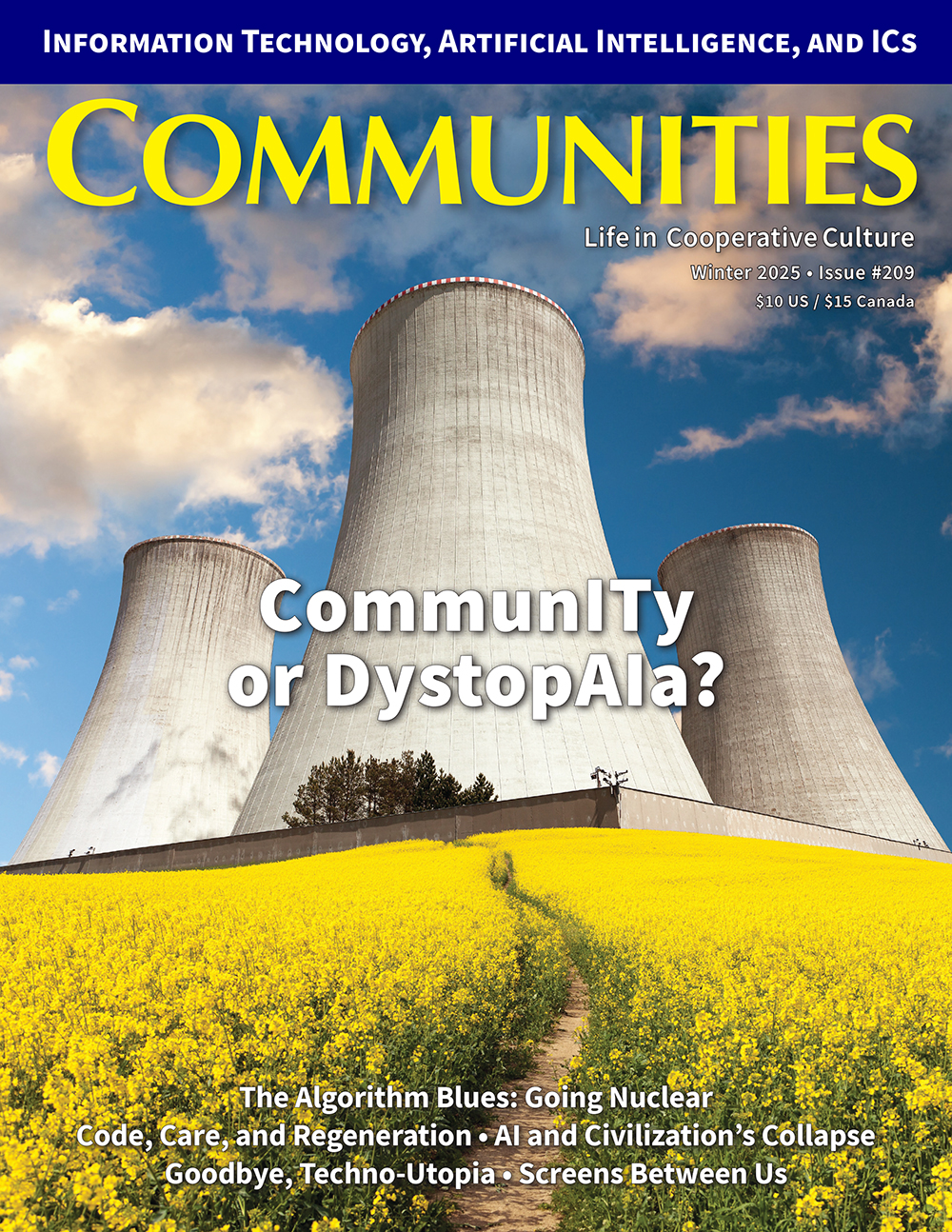
Communities #209
Winter 2025
CommunITy or DystopAIa?
Note: You can order a copy of this issue here.
Communities #209, Winter 2025, “CommunITy or DystopAIa?,” explores the intersections of Information Technology, Artificial Intelligence, and Intentional Community. Articles represent the full range of perspectives from techno-pessimism (“AI and Civilization’s Collapse”) to techno-optimism (“Information Technology, Artificial Intelligence, and the Evolution of Human Consciousness”). Several contributors describe ubiquitous screens as eroding community by isolating us from one another; but one author (assisted by ChatGPT) celebrates screens as a helpful way of tuning out and recharging, and another explains practical AI tools available for seniors. Other stories delve further into the significant ecological, social, cultural, and personal impacts of AI, social media, and digital tools in general, and how they affect life in community.
Notes from the Editor: The AIr Is Fine! (Or Is It?) by Chris Roth
Consolidation, homogenization, damaged ecosystems, and poverty of nutrition are the legacy of the chemical agriculture revolution. The same threatens to happen on a cultural level with the artificial intelligence revolution.
Goodbye, Techno-Utopia by Ben Brownlow
At Dancing Rabbit we used to have a culture where everyone made money online and yet a screen could not be seen in public, outside of our Computer Lab. Now I see them everywhere, even in my own hands, but the money is moving in a different direction.
Screens Between Us: Technology, Intimacy, and the Fight for Presence by Kristina Jansen
We live in what Sherry Turkle calls a state of being “alone together”—each of us tethered to our own screens, trading full conversation for fragmented exchanges.
AI and Civilization’s Collapse by Kara Huntermoon
The internet will end as finite resources are exhausted. The widespread adoption of AI will hasten collapse by accelerating the depletion of resources, while degrading the social infrastructure that we rely on. Good thing our ancestors lived without internet or AI for the vast majority of human history.
The Algorithm Blues: Going Nuclear by Albert Bates
The sad fact is that our intentional communities culture—and that includes the hippie ecovillage ecosystem—is ill-adapted to resist social algorithms engineered for engagement. Meanwhile, Big Tech is turning to nuclear power.
AI: A Conversation by kaseja wilder and Mariner Wilder
In this context of folks gathered to put effort into making the world a better place through community, I did not expect to be met with such a high degree of apathy regarding excess use of resources for notetaking.
AI, Wi-Fi, and the Commune: How Digital Tools Are Reshaping Communal Life—for Better and Worse by Keenan Dakota and ChatGPT
Now, even remote communities can stay plugged in. One minute you’re milking a goat, the next you’re editing a YouTube series on sustainable living or organizing an online mutual aid network.
The Evolution of an ArtIcle by Keenan Dakota, ChatGPT, and the Editor
Others in the community saw AI as the creeping edge of a dystopia where nothing is real, no one is accountable, and creativity is outsourced to a machine that never sleeps. “If we let AI write our poetry,” one elder warned, “then we’re letting it write our future.”
WhatsApp and Email Wars, Happiness, and Community Law by Dr. Nimi Langer
It is constant emails and WhatsApp messages. Why this? Why that? I reply quickly, citing the exact clause and page from our codex. Group emails are the worst; you cannot leave them unanswered.
The Digital Treadmill: Planned obsolescence, the Digital Desert, and other concerns by Rachel Freifelder
The Digital Revolution has changed our culture in ways that force people to participate for their economic survival, and make life difficult for those who attempt to opt out. And we are also pushed to follow the ever-accelerating tide of updates and upgrades and buy new, new, new equipment.
Perspectives from a Tech-Driven Community: Code, Care, and Regeneration by Jillian Hovey, Roberto Valenti, Simon Quarmby, and Laura van Wijngaarden
Re-imagined, digital technology could make our interdependence visible and workable—supporting trust, enabling values-aligned communication, and allowing communities to coordinate across scales, from households to global networks.
Closing the Loneliness Gap: Practical Tech for Aging Adults by Alan O’Hashi
Instead of seeing technology as a substitute for community, we can use it as a bridge that blends digital innovation with human compassion, keeping us all closer, safer, and less alone.
Information Technology, Artificial Intelligence, and the Evolution of Human Consciousness by Millicent Haughey
I feel the deep pull towards living closer to the earth, and the foundational simplicity of being human, while simultaneously experiencing a love affair with what technology can do already and what it might be capable of in the future.
A DAO of Our Own: Using Transparent Tech to Build a Decentralized Care Economy by Erin Freely
Learning AI matters for highly system-impacted communities because the future is being built with or without us, and right now it is continuously being built on us. If we don’t shape these tools, they will keep shaping us.
REACH
News from FIC: Reflecting on 2025
A New Digital Home for the Communities Movement by Eva Goldfarb
No digital tool can replace the smell of fresh-baked bread at a potluck or the feeling of hands in the soil. But it can make those moments easier to find, and it can strengthen the invisible threads tying our communities together.
Digital-Only (see gen-us.net/frenemy):
My Frenemy, Al by Elizabeth Barr
When AI easily provides me with instant summaries of years of research on any topic, or with detailed instructions for any project, my adult-self who’s in a hurry does appreciate it. Reframed, though, that same moment also seems like an overly helpful helicopter parent stealing a learning opportunity.
ON THE COVER: A path through a flowering rapeseed field leads to Dukovany Nuclear Power Station in the Czech Republic. The path through a flowering AI field may lead to many more such stations. (See especially “The Algorithm Blues: Going Nuclear” by Albert Bates, page 20.) Photo by Daniel Prudek.