
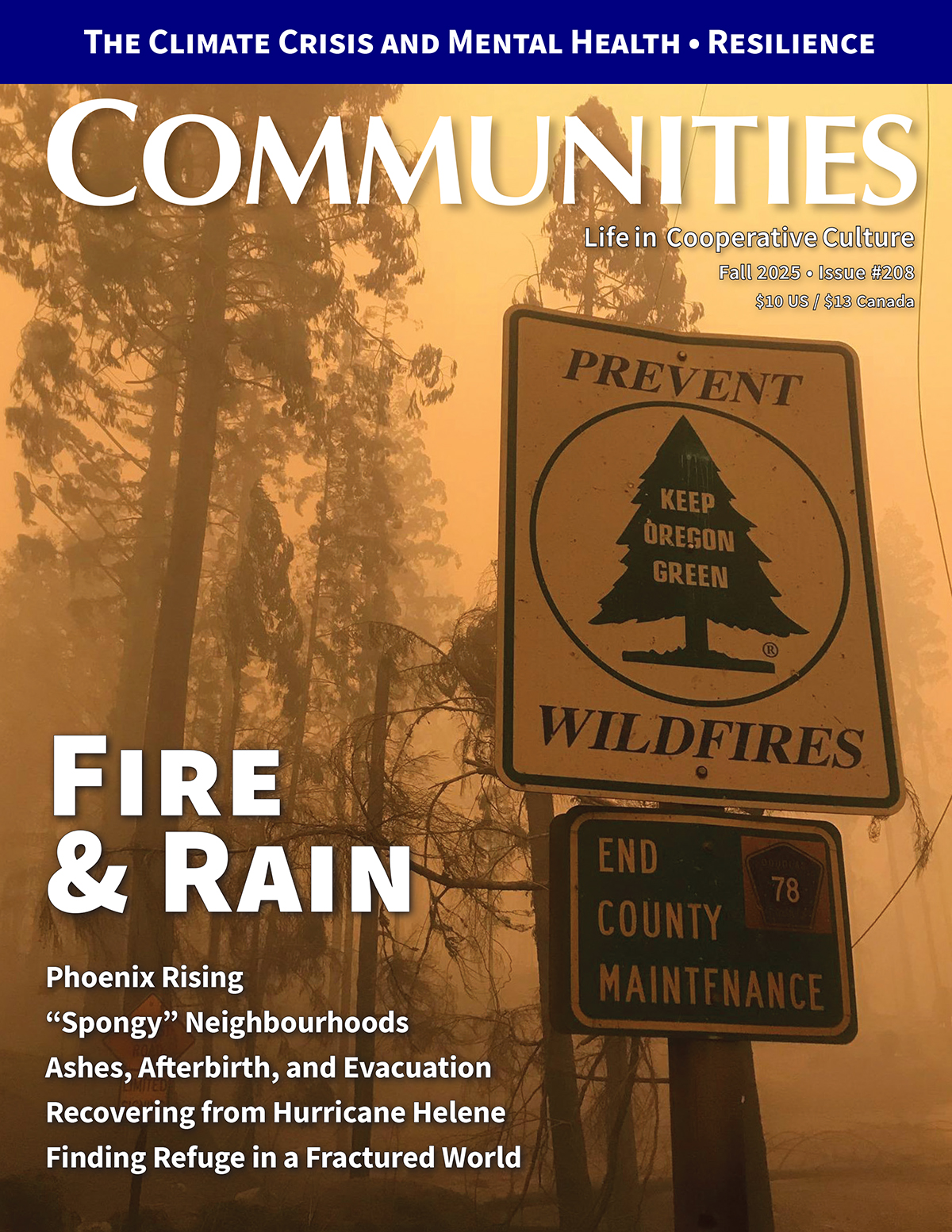
Communities #208
Fall 2025
FIRE AND RAIN
Note: You can order a copy of this issue here.
Communities #208, Fall 2025, Fire and Rain, explores the impacts of climate change, natural disasters, climate anxiety, and related mental health struggles on intentional communities and communitarians. It also describes hopeful strategies and perspectives in response to current crises, and healthier relationships we can have with fire and rain. Additional pieces survey the history of the global ecovillage movement and re-examine the legacy of The Farm.
Notes from the Editor: Staying Sane, Together by Chris Roth
The articles in this issue, whether dealing with literal Fire or Rain or their manifestations within each of us, illustrate the power of community to address what none of us can confront as sole actors.
Fire and Mold by Keenan Dakota
Even as we struggle to recover, we know one thing for certain: climate change is not a distant threat. It is here. It is now. And we must adapt or be crushed beneath the next blow.
People’s emotional responses ranged from excitement about how quickly we were clearing roads and helping neighbors, to feeling devastated and depressed. One villager didn’t leave her house.
Fire and Ice, Sorrow and Soil: Finding Refuge in a Fractured World by Kristina Jansen
Amidst the turmoil of recent personal, professional, and political losses, it’s felt as if the forces of fire and ice are raging around us. The fire of political chaos and social rage. The ice of numbness, fear, and creeping despair.
The Sadness of the World by Yana Ludwig
Today the truths / I’ve collected / like museum pieces / have all gone greyscale.
“Spongy” Neighbourhoods Can Reduce City Flooding by Robin Allison
Earthsong’s overland stormwater system acts like a sponge, allowing the water to soak naturally back into the ground, filtering sediments and nourishing plants, increasing biodiversity and reducing water runoff.
Phoenix Rising by Liz Walker
I ran outside with the others and watched helplessly as 70-foot-high flames spread from duplex to duplex, then jumped the 40-foot gap to the Common House. How could this be happening?
A Tale of Two Co-Ops by Jasper Baton Lydon
As climate patterns shift, regions are having to prepare for new types of disasters they haven’t reckoned with before. For other regions and intentional communities, that type of disaster might be nothing new.
Resilience in the Face of Chaos: Finding New Meaning Amid Despair by Jennifer Jaylyn Morgan
The journey from inspiration and empowerment to despair and helplessness in the face of climate change and biodiversity loss reflects broader societal struggles. Recognizing and validating these feelings is crucial.
The Climate Crisis and Mental Health by Jen Myers
So many of the places I love were burning. Even as my family was not in immediate danger, I was shaken to the core confronting the future I knew would be my daughter’s inheritance.
Ashes, Afterbirth, and Evacuation: A New Mother’s Journey by Corinne Weber, MSN
I had lived in a previous community for a mere five months, and that was long enough to see how toxic behaviors from residents spread like the wildfires, destroying relationships and reputations alike.
Fire at the Fireplace Community by Abby Rampone
Fire is sacred to all humanity. We all recognize its awful (awe-filled) power, both positive and negative, extraordinary and quotidian. Everyone brings their selves and their histories to the fire.
Making an Ecovillage by Belinda Rennie
How do I want to live in these times of increasing climate chaos? What do I want to live for? Who do I want to become in order to live these values and this life I desire? And with whom?
April Fools Bunny: Up in Smoke by Nathaniel Nordin-Tuininga and Quinn Gerald
The first rule of pyromancy is patience, the second is presence. The flames waved in the majestic way that only fire can demonstrate. At once a great calm washed over me.
Alone in the Village by Charles Durrett
Neurotypical persons may need to be the ones trained to modify their behavior to live successfully with the neurodivergent. It is doable in cohousing, but it’s a conscious choice.
The Global Ecovillage Movement by Ross Jackson
Our group concluded that we know what the problems are, and we know what the solutions are; what we need is not more conferences or white papers, but implementation of what we already know.
The Farm’s Legacy Continues: A Response to Martin Holsinger by Michael Traugot
We always knew, and talked about it, that we were an “experimental” community, and experiments don’t “fail” unless we don’t gain any insights from trying them.
Pray Heed My Plea by Jon Swanson
Where oh where are the schlepping carts? / Oh where oh where did they go?
REACH
News from Our Partners: Worldwide Communities at Your Fingertips
ON THE COVER: Once seen as a climate refuge, the Pacific Northwest of the US has turned out not to be in recent years. On a larger scale, smoke from wildfires in the US and Canada has increasingly impacted people not only locally and regionally, but also thousands of miles away. Pictured: smoke from the Archie Creek Fire, which burned over 131,000 acres in southwestern Oregon in September 2020. Photo from US Forest Service (flickr.com/photos/forestservicenw/50380519881/in/album-72157715907119122).